
Complete paper
150 questions in 150 minutes
Each question-paper group has 150 multiple-choice questions and a total duration of two hours and thirty minutes.
NEET-SS practice
Understand the NEET-SS group system, connect your feeder qualification with eligible courses and practise expert clinical decisions under time pressure.
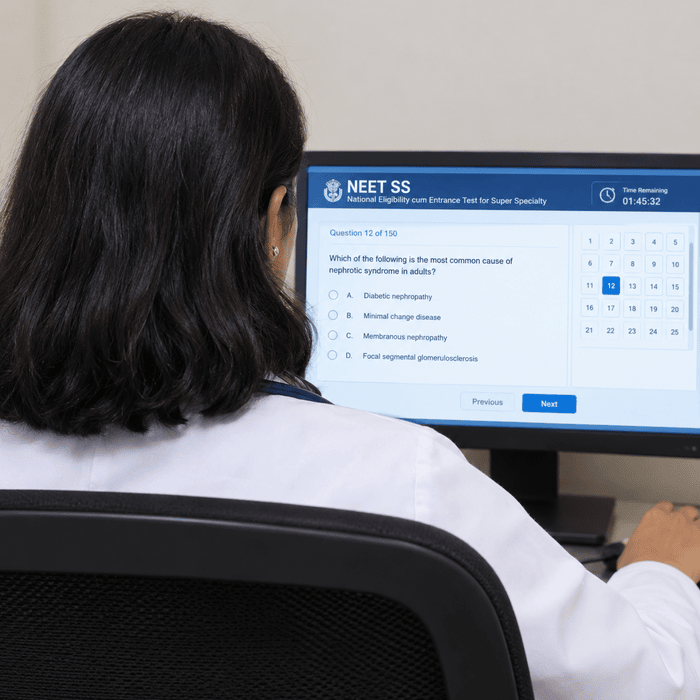
About NEET-SS
The National Eligibility cum Entrance Test for Super Specialty courses, or NEET-SS, is an eligibility-cum-ranking examination conducted by the National Board of Examinations in Medical Sciences. It is the single entrance examination for the DM, MCh and post-MD/MS/DNB DrNB super-specialty courses covered by the applicable information bulletin.
NEET-SS uses a group-based system. Candidates take the question paper group connected with their postgraduate feeder qualification and the super-specialty course they intend to pursue. Qualifying a group allows a candidate to participate in counselling only for courses in that group for which the candidate's own qualification is an eligible feeder.
Use the official NBEMS NEET-SS page for the current bulletin, notices, application link and results.
NEET-SS exam pattern
Complete paper
Each question-paper group has 150 multiple-choice questions and a total duration of two hours and thirty minutes.
Section structure
Sections A, B and C contain 50 questions each. Every section has an independent 50-minute time limit.
Locked progression
The next section begins automatically when the preceding section ends. Responses in a completed section cannot then be reviewed or modified.
Correct response
Each correct answer receives four marks. The maximum score for the complete question paper is 600.
Incorrect response
One mark is deducted for an incorrect answer, while an unattempted question receives zero.
Qualifying criterion
The official bulletin specifies the qualifying percentile and prepares a separate merit list for every question-paper group.
This summary follows the NEET-SS 2025 information bulletin. Candidates should verify the scheme and qualifying criterion in the bulletin for their own admission session.
Eligibility
Recognised qualification
Candidates must hold, or obtain by the session's specified cut-off date, a recognised postgraduate medical degree, provisional pass certificate or equivalent qualification.
Feeder specialty
Eligibility is determined by the feeder qualifications listed for each super-specialty course. A broad specialty may provide access to more than one group or course.
Medical registration
Registration with the National Medical Commission or a State Medical Council is mandatory, subject to the separate provisions stated for foreign nationals.
Possessing a feeder qualification or appearing in a group does not create an automatic right to admission. Apply only after checking the current eligibility annexures, cut-off date and course-specific conditions.
Scope and counselling
Included
NEET-SS covers applicable DM and MCh courses at government, private, university and deemed-university institutions, including applicable Armed Forces Medical Services seats.
DrNB
Post-MD/MS/DNB DrNB super-specialty courses are covered. Direct six-year DrNB programmes are outside this route and use the pathway specified by NBEMS.
Counselling
Qualified candidates participate in national counselling and can select only the courses covered by their qualified group for which their own broad specialty is an eligible feeder.
For the 2025 admission session, AIIMS campuses, PGIMER Chandigarh, JIPMER Puducherry, NIMHANS Bengaluru and SCTIMST Thiruvananthapuram were not covered by centralized NEET-SS admission for their DM/MCh seats. Check the current bulletin because institutional coverage can change.
Question-paper groups
For 13 groups, the paper draws on the general component and all systems or subspecialty components of the primary feeder broad specialty at postgraduate exit level. Critical Care Medicine and Medical Oncology use separate papers based on those super-specialty subjects. The group summaries below are an orientation; the official tables decide exact eligibility.
Clinical breadth
These groups cover broad clinical disciplines and the super-specialty courses mapped to them in the current bulletin.
Primary feeder: General Medicine. Preparation spans the breadth of medicine and its systems, including cardiology, endocrinology, gastroenterology, hepatology, nephrology, neurology, hematology, rheumatology, infectious diseases and genetics.
Primary feeder: General Surgery. Revise broad surgical principles and the systems leading toward courses such as urology, neurosurgery, paediatric surgery, surgical gastroenterology, vascular surgery, plastic surgery and surgical oncology.
Primary feeder: Paediatrics. Cover neonatal and child health at exit level, including critical care, cardiology, gastroenterology, hepatology, nephrology, neurology and oncology.
Primary feeder: Obstetrics and Gynaecology. Integrate advanced obstetric care, reproductive medicine, infertility, operative gynaecology and gynaecological oncology.
Primary feeder: Orthopaedics. Revise trauma, biomechanics, reconstruction, paediatric orthopaedics, hand surgery, imaging and perioperative decision-making.
Specialty practice
Each paper tests its primary feeder specialty at postgraduate exit level and connects it with the super-specialty courses assigned to the group.
Primary feeder: Anaesthesiology. Cover perioperative medicine, advanced airway and ventilation, monitoring, resuscitation and organ-specific anaesthesia.
Primary feeder: Radiology. Strengthen multi-modality interpretation, protocol selection, imaging safety and image-guided diagnostic and interventional principles.
Primary feeder: Respiratory Medicine. Revise complex pulmonary disease, physiology, ventilation, thoracic imaging, sleep medicine and interventional pulmonology.
Primary feeder: Pathology. Integrate morphology, immunohistochemistry, molecular testing, laboratory quality and oncologic diagnosis at postgraduate exit level.
Primary feeder: Microbiology. Cover virology, immunology, molecular diagnosis, infection control and the laboratory interpretation of complex infections.
Focused pathways
These routes include three feeder-based groups and two papers devoted directly to a super-specialty subject.
Primary feeder: Psychiatry. Revise advanced assessment, psychopharmacology, psychotherapy, neurodevelopment, geriatric mental health and child and adolescent psychiatry.
Primary feeder: Pharmacology. Focus on clinical pharmacology, trials, pharmacovigilance, kinetics, interactions, rational therapeutics and research interpretation.
Primary feeder: ENT. Integrate head-and-neck anatomy, airway and swallowing, oncology, imaging and operative decision-making relevant to head and neck surgery.
This dedicated paper tests Critical Care Medicine rather than the complete curriculum of one primary feeder specialty. Preparation should cover resuscitation, ventilation, shock, sepsis and multi-organ support.
This dedicated paper tests Medical Oncology. Revise cancer biology, staging, systemic therapy, treatment toxicities, oncologic emergencies and evidence-guided management.
Some super-specialty courses accept more than one feeder qualification, and eligible candidates may need to sit a group whose primary feeder differs from their own specialty. Use the current bulletin annexures to map your exact qualification, paper group and available courses.
Preparation tips for NEET-SS
Confirm the question paper and courses available for your feeder qualification before planning revision. Do not rely on the name of the desired course alone.
For feeder-based groups, prepare the general component and all systems and subspecialty components at postgraduate exit level rather than studying only the intended super-specialty.
Practise 50-question blocks with a strict timer. Learn to review before a section closes because completed sections cannot be reopened.
Interpret imaging, pathology, monitoring data and treatment algorithms in context. Expert questions often require the next best decision rather than isolated recall.
Record whether errors came from missing knowledge, over-interpretation or unnecessary guessing. Use that evidence to improve selection and accuracy.
Rehearse all three sections consecutively. Review performance by system, question type and decision error so the next revision cycle remains focused.
Before applying
Question-paper groups, feeder qualifications, covered courses, dates, institutional scope and counselling rules can change between sessions. Verify every application and preference decision against the current NBEMS information bulletin, its annexures, subsequent notices and the Medical Counselling Committee website.
NEET-SS FAQ
Schedule information checked on 1 October 2026. Tentative dates remain subject to official revision; use the current NBEMS bulletin and subsequent notices for your application decisions.
The NBEMS notice dated 29 April 2026 lists 11 and 12 December 2026 as the tentative dates for NEET-SS 2026. These are provisional dates, not a guarantee. Check subsequent NBEMS notices and the session's information bulletin before making travel arrangements.
The tentative examination calendar does not specify the application opening or closing dates. Use the application notice and information bulletin linked from the official NBEMS NEET-SS page for the announced window. Do not assume that last year's registration dates will apply again.
Open the official NBEMS NEET-SS page and follow the application link for the correct session. Register, log in, complete the form, upload the required images and documents, select the permitted paper group and test city, pay the fee and submit. Save the confirmation.
Keep your postgraduate qualification details, medical registration details, valid identification, email address and mobile number ready. Prepare the photograph, signature, thumb impression and any prescribed documents in the current bulletin's required formats.
Eligibility can include candidates expecting to obtain the recognised feeder qualification by the prescribed cut-off. The tentative NEET-SS 2026 notice lists 31 January 2027 for completion of the prior entry qualification. Confirm the final eligibility conditions and deadline in the session's bulletin.
Match your recognised postgraduate qualification to the eligible feeder specialties and paper groups in the current bulletin. A desired course's name alone does not establish eligibility. Verify that both the selected group and intended super-specialty course accept your qualification.
Corrections are restricted to the permitted fields and notified edit windows. The 2025 bulletin excluded name, nationality, test city, mobile number and email address from editing. Check the current rules before submission; do not rely on a later correction opportunity.
Use Applicant Login on the official NEET-SS portal when admit cards are released. The current bulletin or notice specifies the release date. Check the venue, examination date, shift and reporting instructions on your admit card.
NBEMS publishes the result schedule and result notices through the official NBEMS NEET-SS page. The tentative exam dates alone do not establish a result date. Check the notice for your examination session and follow the instructions for accessing your result or scorecard.
Follow the MCC Super Speciality Counselling page for the relevant admission session. Counselling requires separate registration and compliance with its payment, choice-filling, allotment and reporting procedures. Verify feeder eligibility and available seats before selecting courses; examination registration does not complete counselling registration.
Practise at postgraduate exit level, strengthen clinical reasoning and build the pacing required for three locked sections.