
Complete paper
200 questions in 180 minutes
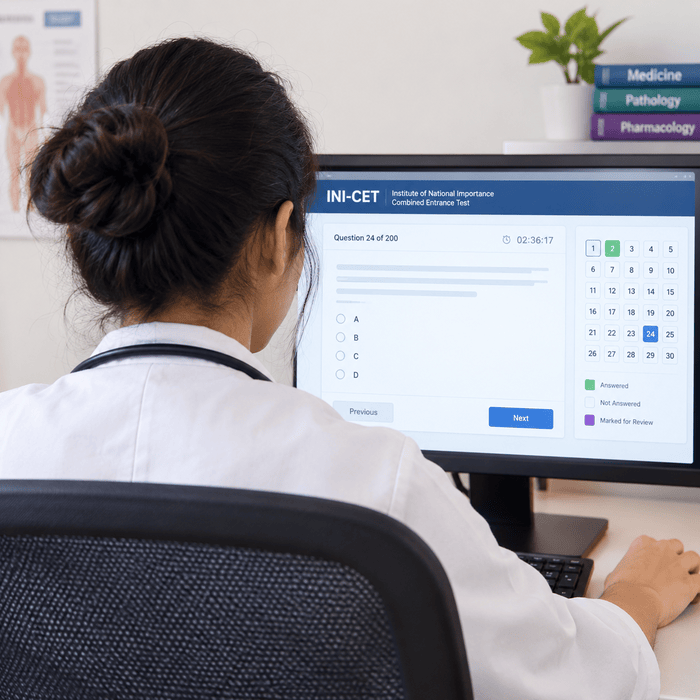
The computer-based examination contains 200 objective questions. The full paper lasts three hours and is divided into four sequential parts.
INI-CET practice
Understand the four-part INI-CET format, revise integrated concepts and practise making accurate decisions under section-wise time limits.
About INI-CET
The Institute of National Importance Combined Entrance Test, or INI-CET, is administered by the Examination Section of AIIMS New Delhi for admission to postgraduate courses at participating Institutes of National Importance. Depending on the institute and session, these may include MD, MS, MDS, six-year DM and MCh programmes, and MD in Hospital Administration.
The examination supports the January and July admission sessions. AIIMS New Delhi manages the combined application, examination, result and seat-allocation process, while each participating institute applies its own admission rules. Candidates must therefore read both Part A of the common prospectus and the relevant institute's Part B prospectus.
Use the official AIIMS INI-CET page for the current prospectus, notices, dates and application links.
INI-CET exam pattern
Complete paper
The computer-based examination contains 200 objective questions. The full paper lasts three hours and is divided into four sequential parts.
Section structure
Each part contains 50 questions and has a separate 45-minute limit. This makes steady pacing necessary throughout the examination.
Time-locked progression
A part closes automatically when its 45 minutes end. Candidates cannot return to an earlier part after it has been submitted.
Correct answer
Each correct response receives one mark. Accuracy matters because the paper also applies negative marking to incorrect responses.
Incorrect answer
One-third of a mark is deducted for an incorrect response. An unanswered question or one left marked for review receives zero.
Qualifying standard
The official prospectus sets category-wise qualifying percentiles. Qualification allows consideration for seat allocation but does not itself guarantee admission.
The structure above follows the official AIIMS INI-CET prospectus. Always check the prospectus for your admission session in case the scheme or qualifying rules change.
Eligibility
Qualifying degree
An MBBS degree is required for the medical postgraduate courses covered by INI-CET, while a BDS degree is required for MDS. The degree must meet the recognition requirements stated in the prospectus.
Practical training
Candidates must complete the required 12-month rotating internship or practical training by the deadline specified for that admission session.
Aggregate marks
The common prospectus specifies 55% aggregate across all professional MBBS or BDS examinations for most categories and 50% for SC and ST candidates. PwBD candidates follow the minimum for their category.
Institute-specific conditions can differ, and some courses have additional requirements. Read the current common prospectus and the Part B prospectus of every institute you may select.
Courses and participating institutes
Medical postgraduate courses
Participating institutes may offer MD and MS seats through INI-CET. MD in Hospital Administration is included where offered and may carry additional experience requirements.
Long-duration specialty training
Selected institutes and specialties may offer direct six-year DM or MCh programmes through the combined examination. Availability changes with each seat matrix.
Dental postgraduate courses
Eligible BDS graduates may compete for MDS seats at participating institutes. They should follow the dental eligibility and syllabus information relevant to their stream.
The participating institutions can include AIIMS campuses, PGIMER Chandigarh, JIPMER Puducherry, NIMHANS Bengaluru and SCTIMST Thiruvananthapuram. Courses, specialties and seats are not identical across institutes or sessions. Use the current official seat position and each institute's Part B prospectus when building your preference order.
INI-CET syllabus
INI-CET preparation draws on the subjects taught during the MBBS course and rewards the ability to connect foundational science with diagnosis, investigation and management. AIIMS does not promise a fixed number of questions from every subject, so the three-part grouping below is a revision framework rather than an official subject-wise weightage.
Part A
Build the structural, functional and biochemical base needed to interpret disease and clinical findings.
Revise gross and regional anatomy, neuroanatomy, embryology, histology and clinically relevant relationships. Practise identifying structures from diagrams, imaging and procedural contexts.
Understand normal function, regulation and adaptation across organ systems. Link mechanisms and graphs with symptoms, examination findings and common physiological disturbances.
Connect metabolism, molecular biology, nutrition, enzymes and genetics with inherited disorders, laboratory interpretation and the biochemical basis of disease.
Part B
Use mechanisms of disease, medicines, microbes, population evidence and medico-legal principles to explain clinical decisions.
Cover general and systemic pathology, hematology, neoplasia and diagnostic morphology. Relate mechanisms and microscopic findings to presentation, investigations and prognosis.
Revise mechanisms, indications, adverse effects, interactions, contraindications and rational prescribing. Give special attention to treatment choices in common clinical scenarios.
Integrate bacteriology, virology, parasitology, mycology and immunology with specimen selection, laboratory diagnosis, infection control and antimicrobial use.
Review medico-legal duties, injuries, death, identification, consent, ethics and common poisonings, including immediate stabilization and antidotal management.
Apply epidemiology, biostatistics, screening, prevention, national programmes and health-system principles to population-level and evidence-based questions.
Part C
Interpret presentations, prioritise investigations and choose safe, evidence-based management across major specialties.
Integrate history, examination, laboratory data and imaging across medical specialties. Emphasise emergencies, common diseases, differential diagnosis and evidence-based management.
Revise surgical assessment, trauma, fluids, shock, perioperative care and common specialty problems. Practise choosing the next investigation or intervention.
Cover antenatal care, labour, obstetric emergencies, reproductive health, menstrual disorders, gynecologic disease and appropriate diagnostic and management pathways.
Focus on growth, development, nutrition, immunisation, neonatal care and common childhood illness, using age-specific interpretation and management.
Review fractures, dislocations, bone and joint infections, tumors, degenerative disease and rehabilitation, with attention to imaging and urgent stabilization.
Recognise common eye disease, visual pathway findings and ocular emergencies. Link examination techniques and investigations to timely treatment.
Revise disorders of the ear, nose, throat, head and neck, including hearing assessment, airway emergencies, infections and common tumors.
Use lesion morphology and distribution to distinguish inflammatory, infectious, autoimmune and neoplastic conditions, including relevant systemic associations.
Cover diagnostic patterns, risk assessment, psychopharmacology, psychological therapies, substance use and the legal and ethical aspects of mental healthcare.
Develop a systematic approach to common X-ray, CT, MRI and ultrasound findings, and select suitable imaging while considering contrast and radiation safety.
Review preoperative assessment, airway management, anesthetic agents, monitoring, pain control, resuscitation and recognition of perioperative complications.
MDS candidates should organise their preparation around the undergraduate dental curriculum and the current dental admission information. The subject framework above is intended for the medical stream.
Preparation tips for INI-CET
Study one clinical problem through anatomy, physiology, pathology, pharmacology, diagnosis and management. This makes knowledge easier to retrieve in application-based questions.
Work regularly with radiographs, pathology images, ECGs, graphs and laboratory patterns. Explain the finding before deciding what the question is asking.
Use sets of 50 questions to reproduce the official section structure. Learn when to move on because unused time cannot be carried into a later part.
For every error, identify whether the cause was a knowledge gap, a missed clue, an incorrect interpretation or an avoidable risk under negative marking.
Use compact notes, tables and spaced recall for volatile facts, while preserving time for clinical application and mixed-subject practice.
Complete four consecutive timed parts before the examination. Full simulations reveal pacing, concentration and decision-making problems that short sets may hide.
Before applying
Dates, seat matrices, institute participation, eligibility details, reservation rules and application steps can change between admission sessions. Use preparation resources for explanation and practice, but verify every application and admission decision against the official AIIMS INI-CET portal, the current Part A prospectus and the applicable institute's Part B prospectus.
INI-CET FAQ
These answers explain the general admission framework and the referenced AIIMS examination format. Check the prospectus and notices for your own session before making application or admission decisions.
INI-CET means Institute of National Importance Combined Entrance Test. The Examination Section of AIIMS New Delhi administers the examination and combined seat-allocation process.
Participating institutes use INI-CET for MD, MS, MDS, six-year DM and MCh programmes, and MD in Hospital Administration where offered. Check the session's seat matrix for available courses.
Participating institutions include AIIMS campuses, JIPMER Puducherry, PGIMER Chandigarh, NIMHANS Bengaluru and SCTIMST Thiruvananthapuram. Course availability and institute-specific admission conditions differ.
Medical applicants generally need a recognised MBBS degree; MDS applicants need a recognised BDS degree. Internship, aggregate marks and institute-specific conditions must also be satisfied. Separate provisions apply to overseas qualifications and nationalities.
You must complete the required 12-month rotating internship or practical training by the cut-off for your admission session. Check that deadline before applying; taking the examination does not override eligibility requirements.
For Indian nationals qualifying in India, the referenced common prospectus requires 55% aggregate across professional examinations for categories other than SC/ST, and 50% for SC/ST. PwBD applicants follow their respective category threshold. Verify the current prospectus.
The referenced AIIMS format is a computer-based test with 200 objective questions in 180 minutes, including single-correct and multiple-correct questions. There are four parts, each containing 50 questions with 45 minutes allotted.
Under the referenced time-locked format, only the current part is accessible. After 45 minutes it closes automatically and the next part opens. Earlier parts cannot be revisited, so finish your review within the active part.
The referenced marking scheme awards +1 for a correct answer and deducts one-third of a mark for an incorrect answer. Unanswered questions and questions left marked for review receive zero. Follow the session-specific examination instructions.
No. Admission depends on merit, eligibility, choices, available seats, reservation rules and document verification. Qualified candidates must follow the separate online seat-allocation process and reporting instructions.
Part A explains the common examination and application framework. Part B sets out each institute's course-specific eligibility and admission conditions. Read both before choosing an institute or specialty.
Visit the official AIIMS examination website and open Academic Courses, then INI-CET. Check the current prospectus, application instructions, notices and seat-allocation announcements.
Build accuracy across the MBBS curriculum, practise timed sections and learn from each answer before moving to a full mock.