
Complete examination
77 questions for 400 marks
The official paper contains 25 Mathematics questions, 50 Aptitude questions and 2 Drawing questions. The total duration is three hours.
JEE Main Paper 2A practice
Build Mathematics accuracy and architectural aptitude for JEE Main Paper 2A while preparing separately for its offline Drawing Test.
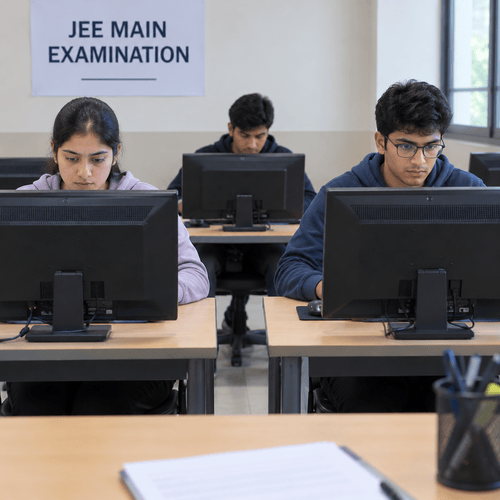
About Paper 2A
JEE Main Paper 2A is conducted for admission to B.Arch programmes. The official examination combines computer-based Mathematics and Aptitude sections with a Drawing Test completed offline on a drawing sheet.
ExamAcers practice for Paper 2A covers only the Computer Based Test components: Mathematics and the Aptitude Test. It does not deliver or evaluate the offline Drawing Test. This scope will also be stated explicitly wherever Paper 2A practice products are offered.
For current notices, the information bulletin and candidate activity, use the official JEE Main website.
Paper 2A exam pattern
Complete examination
The official paper contains 25 Mathematics questions, 50 Aptitude questions and 2 Drawing questions. The total duration is three hours.
Part I
Section A contains 20 MCQs and Section B contains 5 numerical-value questions. Mathematics contributes 100 marks.
Part II
The Aptitude Test contributes 200 marks and assesses visualisation, spatial understanding, architectural awareness and mental ability.
Part III
The Drawing Test contributes 100 marks and is attempted offline on an A4 drawing sheet. It is not included in ExamAcers tests.
Objective marking
For MCQs and numerical-value questions, a correct response receives 4 marks, an incorrect response deducts 1 mark and an unanswered response receives no mark.
Numerical answers
Section B answers are entered through an on-screen virtual numeric keypad and rounded to the nearest integer under the 2026 instructions.
ExamAcers Paper 2A products cover the 75 computer-based Mathematics and Aptitude questions only. They do not simulate, score or include the two offline Drawing Test questions.
Paper 2A syllabus
The official syllabus defines all three parts of the examination. The summaries below explain their broad demands; candidates should still read the NTA syllabus line by line before finalizing preparation.
Part I · 100 marks
The Mathematics syllabus covers the same core unit structure used for Paper 2B, spanning algebra, calculus, coordinate and three-dimensional geometry, vectors, statistics, probability and trigonometry.
Sets, relations and functions; complex numbers; quadratic equations; matrices and determinants; counting; binomial theorem; sequences and series.
Limits, continuity, differentiability, applications of derivatives, integration and differential equations.
Coordinate geometry, three-dimensional geometry, vector algebra, statistics, probability and trigonometry.
Part II · 200 marks
Aptitude questions examine awareness of the built environment, visualisation, spatial relationships, analytical reasoning and the ability to understand forms and compositions.
People, buildings, materials, objects and textures connected with architecture and the built environment.
Visualising three-dimensional objects from two-dimensional drawings and identifying different views of an object.
Understanding scale and proportion in objects, building forms and elements, together with colour, texture, harmony and contrast.
Union, subtraction and rotation of forms; surface and volume development; plans, elevations, views and compositions using given shapes.
Visual, numerical and verbal reasoning used to interpret relationships, patterns, forms and spatial information.
Part III · 100 marks
The official syllabus includes sketching scenes and activities from memory across urban, landscape and rural contexts. Candidates should separately practise observation, proportion, perspective, composition and clear visual communication on paper.
This offline part remains essential to the real Paper 2A score but falls outside the scope of ExamAcers’ computer-based practice products.
Read the complete official JEE Main syllabus for the precise topic wording.
Eligibility and admission
Taking JEE Main
The 2026 examination had no age limit and permitted candidates who passed Class 12 or equivalent in 2024 or 2025, or were appearing in 2026. Recheck the permitted years for the relevant cycle.
B.Arch academic requirement
The 2026 bulletin required Physics and Mathematics at 10+2 with one specified additional subject and at least 45% aggregate, or a 10+3 diploma with Mathematics and at least 45% aggregate.
Admission
A Paper 2A score does not itself guarantee admission. Programme eligibility, category, rank, preferences, seat availability and document verification remain relevant.
B.Arch eligibility can be revised. Verify the current NTA bulletin, Council of Architecture requirements and the rules of every intended institution before applying.
Preparation tips for Paper 2A
Maintain distinct progress records for Mathematics, Aptitude and Drawing so strength in one part does not conceal neglected work in another.
Solve numerical questions without answer choices and verify signs, arithmetic and nearest-integer rounding before entering the response.
Rotate, combine and unfold forms mentally; connect plans and elevations with three-dimensional objects; and practise reading scale and proportion quickly.
Observe buildings, materials, textures, public spaces and familiar objects. Ask how form, construction, function and human use relate.
ExamAcers covers only the CBT components, so schedule separate timed drawing sessions using the official syllabus and physical materials.
Separate conceptual gaps from calculation errors, missed visual cues and rushed decisions. Targeted correction is more useful than repeating undiagnosed sets.
Before applying
Dates, fees, documents, qualifying years, examination cities, drawing instructions and admission conditions can change. Verify them through the current NTA bulletin, admit card, counselling authority and intended institutions.
Frequently asked questions
A 2027 registration schedule has not been verified as of 12 October 2026. Check the official JEE Main website for the next bulletin and application notice.
NTA permits paper combinations specified in the current application and fee table. Select every required paper in the application and pay the applicable combined fee.
Under the 2026 pattern, candidates taking both had three hours and thirty minutes. Confirm the duration and shift instructions on the current admit card.
Under the 2026 rules, the better total NTA score—not a combination of the best part scores from different sessions—was used for further processing.
No. It is a normalized percentile score derived from relative performance in a session, not the percentage of raw marks obtained.
Follow the current bulletin and admit-card instructions. The official syllabus advises candidates to bring the permitted drawing and geometry materials; centre rules determine what may be carried into the examination room.
No. ExamAcers Paper 2A practice covers Mathematics and Aptitude in CBT format only. Drawing practice and evaluation must be arranged separately.
Follow current NTA instructions. For 2026, calculators were not permitted; the numerical-response keypad only enters an answer and does not perform calculations.
Follow the counselling or institute application applicable to the colleges you are targeting. NTA conducts the examination and issues scores but does not complete admission for every institution.
No. Admission also depends on academic eligibility, category, preferences, seat availability, counselling participation and successful document verification.
Current-cycle facts were checked against the official JEE Main 2026 Information Bulletin and syllabus on 12 October 2026. Recheck the next bulletin when NTA opens the following cycle.
Practise Mathematics and architectural aptitude in exam-style formats while continuing separate preparation for the offline Drawing Test.