
Paper format
50 compulsory questions
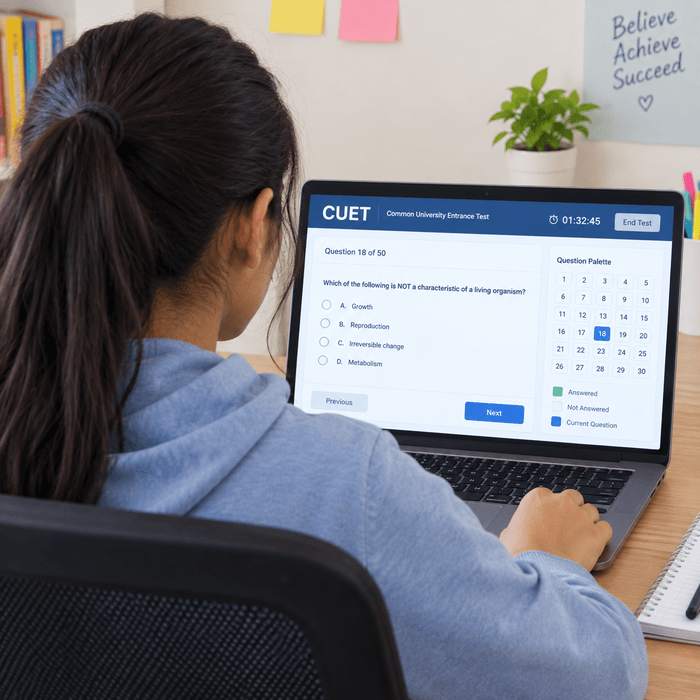
Each test paper contains 50 multiple-choice questions. The official 2026 bulletin provides 60 minutes for each paper, and the examination is conducted in Computer Based Test mode.
CUET UG practice
Understand the CUET UG structure, choose subjects carefully and build focused practice around your university goals.
About CUET
The Common University Entrance Test for undergraduate programmes, or CUET (UG), is conducted by the National Testing Agency for admission to Central Universities and other participating universities, institutions and organizations. It provides a common testing platform while each participating institution continues to set its own programme eligibility, subject combination and admission requirements.
A candidate's useful CUET combination therefore depends on the course and universities being targeted. Before selecting papers, check the current prospectus or admission website of every intended institution. A strong score in the wrong combination may not satisfy a programme's eligibility rules.
For current notices, the information bulletin and institutional updates, use the official CUET UG website.
CUET exam pattern
Paper format
Each test paper contains 50 multiple-choice questions. The official 2026 bulletin provides 60 minutes for each paper, and the examination is conducted in Computer Based Test mode.
Scoring
A correct response receives 5 marks, an incorrect response deducts 1 mark and an unanswered question receives no mark.
Paper choice
Candidates may select a maximum of five papers, including languages and the General Aptitude Test. The combination must follow the eligibility rules of the desired programmes and universities.
Available papers
CUET UG 2026 offers 13 languages, 23 domain-specific subjects and one General Aptitude Test. Each chosen paper is assessed separately.
Medium
The examination is offered in Assamese, Bengali, English, Gujarati, Hindi, Kannada, Malayalam, Marathi, Odia, Punjabi, Tamil, Telugu and Urdu.
Scheduling
Papers are scheduled in multiple shifts according to candidate numbers and subject choices. The admit card gives the binding date, shift and centre for each candidate.
These details follow the CUET (UG) 2026 Information Bulletin. NTA may revise operational arrangements, so candidates should check the bulletin and current public notices before an actual sitting.
CUET exam syllabus
The syllabus is organized by paper rather than as one common syllabus for every candidate. Language papers test comprehension and language ability, domain papers follow the published subject syllabus, and the General Aptitude Test measures general awareness, numerical ability and reasoning.
Category 1
The 13 language papers assess reading comprehension through factual, literary and narrative passages, together with literary aptitude and vocabulary. Candidates should practise reading accurately under time pressure and interpreting meaning from context.
Category 2
The 23 domain papers draw on the syllabus published for the selected subject and are based on the NCERT syllabus specified by NTA. Preparation should begin with the official subject PDF and the corresponding Class 12 concepts.
Category 3
This paper covers general knowledge, current affairs, general mental ability, numerical ability, quantitative reasoning, and logical and analytical reasoning.
Download the current paper-specific documents from the official CUET UG 2026 syllabus page.
Subject details
Use these summaries to identify the broad purpose of each paper, then consult its official syllabus before planning revision. They are orientation notes and do not replace NTA's unit-by-unit syllabus documents.
13 papers
English, Hindi, Assamese, Bengali, Gujarati, Kannada, Malayalam, Marathi, Odia, Punjabi, Tamil, Telugu and Urdu use a shared assessment approach centred on comprehension, vocabulary and literary aptitude. Choose a language only after checking what the intended programme accepts or requires.
23 papers
Domain papers assess knowledge within a named academic field. The exact units and inclusions are defined in the official PDF for each paper.
This paper covers accounting for partnership firms and companies, financial statements, analysis of financial information and the use of accounting information in decision-making. Candidates should be comfortable with concepts, formats and numerical application.
Agriculture brings together crop production, soil and nutrient management, horticulture, livestock, agricultural economics and related technologies. Preparation should connect scientific principles with practical farm and production situations.
Anthropology examines human biological and cultural variation, society, prehistory and applied anthropology. Revision involves key concepts, evidence, terminology and the interpretation of human development and social organization.
This combined paper covers reproduction, genetics and evolution, biology and human welfare, biotechnology, and ecology and environment. Candidates should understand processes, diagrams, experimental ideas and applications rather than rely only on isolated facts.
Business Studies focuses on management principles and functions, business finance, financial markets, marketing and consumer protection. Case-based questions reward accurate application of concepts to business situations.
Chemistry spans physical, inorganic and organic concepts prescribed in the official syllabus. Preparation should balance calculations, reactions, structures, trends and the reasoning used to connect observations with chemical principles.
Environmental Science studies ecosystems, natural resources, biodiversity, pollution, sustainability and human interaction with the environment. Questions may require interpretation of environmental processes, impacts and management approaches.
This paper assesses programming and computational thinking together with databases, data handling, networks and related information practices specified for the chosen stream. Regular code tracing and query practice are useful alongside theory.
Economics covers microeconomic and macroeconomic ideas, national income, money and banking, government budget, balance of payments and Indian economic development. Candidates should practise graphs, numerical relationships and data interpretation.
This paper covers the history, traditions, methods and visual language of the fine and commercial arts included in the syllabus. Preparation combines recognition of works and styles with understanding of materials, techniques and cultural context.
Geography and Geology examine physical processes, resources, human activity, regional patterns and spatial information. Maps, diagrams, distributions and the interpretation of geographical or geological evidence are central to preparation.
History covers the themes, periods, sources and interpretations listed in the official syllabus. Effective revision connects events and institutions with chronology, evidence, historical arguments and their wider social and political setting.
Home Science integrates nutrition, human development, family and community resource management, textiles, communication and related applications. Questions often connect principles with household, community and professional contexts.
This interdisciplinary paper explores Indian knowledge traditions across intellectual, scientific, artistic and practical fields. Candidates should follow the official themes closely and understand the ideas in their historical and cultural contexts.
Mass Media and Mass Communication cover communication processes, journalism, advertising, radio, television, cinema, digital media and media literacy. Revision should include terminology, production contexts, audiences and ethical considerations.
This paper tests the mathematical topics and methods specified for Mathematics or Applied Mathematics. Success depends on conceptual clarity, accurate calculation, recognition of suitable methods and repeated timed problem-solving.
Performing Arts covers the theory, vocabulary, traditions, practitioners and performance conventions relevant to the selected discipline. Candidates should align preparation with the specific dance, drama or music syllabus applicable to them.
Physical Education covers sports training, physiology, psychology, biomechanics, fitness, health, yoga and the organization of sporting activity. Preparation combines factual knowledge with application to performance and well-being.
Physics assesses the principles, relationships and applications set out in the official syllabus. Candidates should combine formula knowledge with diagrams, units, estimation, experimental reasoning and sustained numerical practice.
Political Science examines contemporary world politics and politics in India since independence, including institutions, events, ideas and debates. Revision should connect factual developments with causes, consequences and competing perspectives.
Psychology covers variation in psychological attributes, personality, stress, disorders, therapeutic approaches, attitudes, groups and social influence. Candidates should distinguish related concepts and apply them to examples and situations.
Sanskrit is listed by NTA as a domain paper as well as being represented among the language choices. Candidates must follow the specific domain syllabus, which may assess prescribed language, literature and textual components.
Sociology studies Indian society, social institutions, inequality, cultural change and the processes of development and transformation. Preparation should connect core concepts and sociological perspectives with evidence and contemporary examples.
1 paper
The General Aptitude Test covers general knowledge and current affairs, general mental ability, numerical ability, quantitative reasoning, and logical and analytical reasoning. Build speed through regular mixed practice while maintaining a habit of reviewing errors by topic.
The 37-paper list and category names follow the official CUET UG 2026 syllabus. NTA does not require every candidate to take every category; the permitted and required combination is determined by the candidate's chosen programme and university.
Choose your papers
List the degree programmes and participating universities you are genuinely considering. Include alternatives so that your paper choice supports more than one viable admission route.
For each programme, record the required language, domain papers, General Aptitude Test requirement, Class 12 prerequisites and any university-specific conditions.
Compare the lists and select no more than five CUET papers that preserve your intended options. Recheck the latest university prospectuses before submitting the application.
Admission and eligibility decisions belong to participating universities. NTA conducts the examination and supplies scores; it does not decide each university's programme-specific eligibility.
Preparation tips for CUET exam
Download the syllabus PDF for every chosen paper and turn its units into a revision tracker. This prevents broad textbook reading from displacing topics that are actually examinable.
Revise the relevant NCERT concepts and examples for domain subjects. For languages, practise varied passages and vocabulary; for aptitude, rebuild arithmetic and reasoning fundamentals before chasing speed.
Use short question sets after each topic and explain why each rejected option is wrong. This reveals weak understanding that passive rereading can conceal.
Progress from untimed accuracy to timed sets and complete papers. With 50 compulsory questions in 60 minutes, pacing and prompt decisions matter alongside subject knowledge.
Track whether mistakes arise from missing knowledge, rushed reading or risky guessing. Practise eliminating options and reserve blind guesses, since an incorrect response loses one mark.
After every test, record the topic, error type and correction. Revisit that record weekly and retest recurring weaknesses until the same mistake stops appearing.
Before exam day
Exam patterns, dates, subject lists and university requirements can change between admission cycles. Use preparation websites for explanation and practice, but verify decisions against the current NTA information bulletin, the official syllabus collection and the admission pages of your selected universities.
Frequently asked questions
A 2027 CUET UG date has not been verified as of 1 October 2026. Check the official CUET UG portal for announcements.
The next application window is not yet verified. Wait for NTA's notice; previous-year deadlines do not apply automatically.
Apply through the official CUET UG portal: register, complete the form, upload the required images and documents, pay the fee and save the confirmation page.
The 2026 rules allow Class 12 passed or appearing candidates. Admission still depends on meeting the university's programme requirements.
The 2026 examination has no age limit, but universities may impose their own admission conditions.
Match papers to each shortlisted programme's eligibility requirements. The 2026 limit is five papers, including languages and General Aptitude Test.
The 2026 examination permits this. University prerequisites still apply, so paper selection alone does not establish admission eligibility.
Choose it where your intended programme requires it; check the university's specified paper combination.
The 2026 fee depends on category, number of papers and whether the centre is outside India. Check the applicable bulletin before paying.
NTA's 2026 FAQs permit DigiLocker documents for the application. Follow the current upload instructions.
Contact the payment provider and, if unresolved, the NTA helpdesk. Keep transaction details and payment evidence.
Use NTA's university list and confirm programme details on each university's admission website; participation can change.
Download the admit card from the official portal and check the assigned date, shift and centre. Follow its reporting instructions.
No. Universities apply their own eligibility, merit and document-verification requirements; a score alone does not guarantee a seat.
Follow each university's admission registration and counselling process. NTA conducts CUET and publishes scores; universities manage admissions.
Application and eligibility details above refer to NTA's 2026 information bulletin and FAQs. Recheck the current bulletin when the next application cycle opens.
Review each result, identify weak topics and return to the syllabus with a clearer plan.