
Paper format
Three-hour CBT
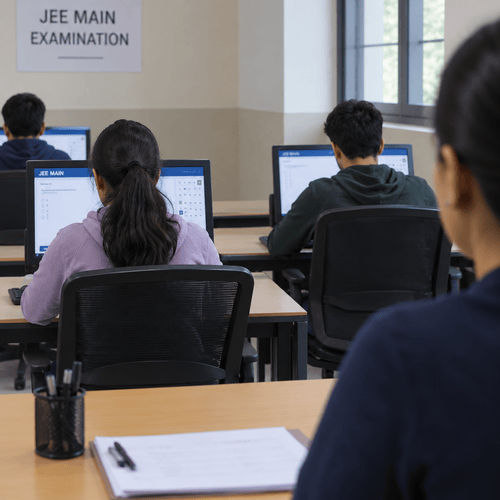
All three parts are delivered in Computer Based Test mode. The complete paper contains 100 questions and carries 400 marks.
JEE Main Paper 2B practice
Build numerical accuracy, spatial reasoning and planning awareness for the fully computer-based JEE Main Paper 2B.
About Paper 2B
JEE Main Paper 2B is conducted for admission to B.Planning programmes. It combines Mathematics, an Aptitude Test and Planning-Based Questions in one Computer Based Test.
The paper connects mathematical methods and spatial understanding with awareness of settlements, development, society, public policy, maps, data and analytical reasoning. Preparation should therefore balance calculation with interpretation and real-world context.
For current notices, the information bulletin and candidate activity, use the official JEE Main website.
Paper 2B exam pattern
Paper format
All three parts are delivered in Computer Based Test mode. The complete paper contains 100 questions and carries 400 marks.
Part I
Section A contains 20 MCQs and Section B contains 5 numerical-value questions. Mathematics contributes 100 marks.
Part II
The Aptitude Test contributes 200 marks and assesses visualisation, spatial understanding, built-environment awareness and mental ability.
Part III
Planning-Based Questions contribute 100 marks across general awareness, social sciences, map and data skills, reasoning and quantitative interpretation.
Marking
A correct response receives 4 marks, an incorrect response deducts 1 mark and an unanswered response receives no mark across the objective sections.
Numerical answers
Mathematics Section B answers are entered through the on-screen virtual numeric keypad and rounded to the nearest integer under the 2026 instructions.
These details follow the JEE Main 2026 Information Bulletin. Check the current official bulletin before the applicable examination cycle.
Paper 2B syllabus
The official syllabus lists the topics for all three parts. Use these summaries to organize revision, then compare your plan with the complete NTA syllabus PDF.
Part I · 100 marks
The Mathematics component spans algebra, calculus, coordinate and three-dimensional geometry, vectors, statistics, probability and trigonometry.
Sets, relations and functions; complex numbers; quadratic equations; matrices and determinants; counting; binomial theorem; sequences and series.
Limits, continuity, differentiability, applications of derivatives, integration and differential equations.
Coordinate geometry, three-dimensional geometry, vector algebra, statistics, probability and trigonometry.
Part II · 200 marks
This part assesses built-environment awareness, visualisation of forms and views, scale and proportion, two- and three-dimensional transformations, composition and analytical mental ability.
People, buildings, materials, objects and textures related to architecture and the built environment.
Interpreting three-dimensional objects from two-dimensional drawings, views, plans, elevations, surfaces and volumes.
Visual, numerical and verbal mental ability together with proportion, colour, texture, form transformation and composition.
Part III · 100 marks
Planning questions combine contextual knowledge with the ability to understand development patterns, society, governance and information presented through maps, charts and tables.
Prominent cities, development issues, government programmes and general knowledge relevant to human settlements and planning contexts.
Nationalism, colonialism, industrialisation, colonial cities, urbanisation, rural development, social structure, exclusion and inequality.
Resources, agriculture, water, minerals, industries, economic sectors, globalisation, development, poverty and population.
Power-sharing, federalism, political parties, democracy and the Constitution of India in relation to society and development.
Reading comprehension, map scale and direction, critical reasoning, charts, graphs, tables, basic statistics and quantitative reasoning.
Read the complete official JEE Main syllabus for the precise topic wording and inclusions.
Eligibility and admission
Taking JEE Main
The 2026 examination had no age limit and permitted candidates who passed Class 12 or equivalent in 2024 or 2025, or were appearing in 2026. Recheck the permitted years for the relevant cycle.
Academic eligibility
Check the Class 12 subjects, aggregate or percentile conditions and any other requirements stated by the counselling authority and every intended B.Planning institution.
Admission
Rank, category, preferences, seat availability, counselling participation and document verification all affect the final admission outcome.
NTA conducts the examination and issues scores. Confirm admission eligibility through the current counselling rules and the institutions to which you intend to apply.
Preparation tips for Paper 2B
Maintain separate progress records for Mathematics, Aptitude and Planning so that broad reading does not replace numerical or visual practice.
Solve numerical questions without answer choices and check signs, arithmetic and nearest-integer rounding before entering a response.
Regularly interpret scale, direction, plans, elevations, spatial transformations and three-dimensional forms from limited visual information.
Relate cities, settlements, resources, society, governance and economic development instead of memorising disconnected facts.
Practise extracting conclusions from passages, tables, charts and maps while distinguishing evidence from assumptions.
Use three-hour mocks to refine section order, question selection and review strategy, then classify every error before the next attempt.
Before applying
Dates, application fields, fees, documents, examination cities, qualifying years and programme eligibility can change. Verify the current NTA bulletin, admit card, counselling documents and institutional admission rules.
Frequently asked questions
A 2027 registration schedule has not been verified as of 12 October 2026. Check the official JEE Main website for the next bulletin and application notice.
NTA permits the paper combinations listed in the current application and fee table. Select every required paper in the application and pay the applicable combined fee.
Under the 2026 pattern, candidates taking both had three hours and thirty minutes. Confirm the applicable duration and shift instructions on the current admit card.
Under the 2026 rules, the better total NTA score—not a combination of the best part scores from separate sessions—was used for further processing.
No. It is a normalized percentile score derived from relative performance in a session, not the percentage of raw marks obtained.
Follow current NTA instructions. For 2026, calculators were not permitted; the numerical-response keypad only enters an answer and does not perform calculations.
No. Drawing is part of Paper 2A. Paper 2B instead contains Planning-Based Questions, and all three Paper 2B parts are computer-based.
Follow the counselling or separate institute application applicable to your target colleges. NTA conducts the examination and issues scores but does not complete admission for every institution.
Institutions may accept JEE Main Paper 2B scores through common counselling or their own processes. Each institution can impose separate programme eligibility and application requirements.
No. Admission also depends on academic eligibility, category, preferences, seat availability, counselling participation and document verification.
Current-cycle facts were checked against the official JEE Main 2026 Information Bulletin and syllabus on 12 October 2026. Recheck the next bulletin when NTA opens the following cycle.
Build Mathematics, visual reasoning and planning awareness through focused work before moving to complete Paper 2B mocks.