
Paper format
75 questions for 300 marks
Mathematics, Physics and Chemistry each contribute 25 questions and 100 marks. All questions are compulsory under the 2026 pattern.
JEE Main Paper 1 practice
Understand the JEE Main Paper 1 structure, cover the official syllabus and build the speed and accuracy required for B.E. and B.Tech entrance.
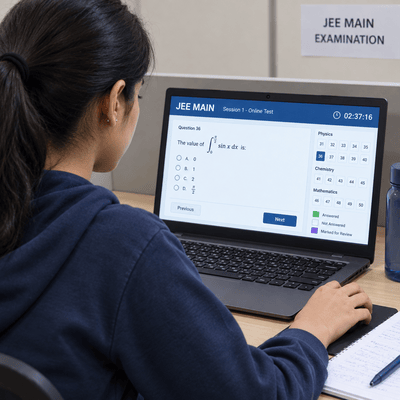
About Paper 1
JEE Main Paper 1 is conducted by the National Testing Agency for admission to undergraduate engineering programmes, including B.E. and B.Tech courses at NITs, IIITs, other Centrally Funded Technical Institutions and participating institutions. It is also the qualifying examination for candidates seeking to appear in JEE Advanced, subject to the applicable eligibility conditions.
The paper gives equal weight to Mathematics, Physics and Chemistry. Preparation therefore needs both complete syllabus coverage and the ability to switch accurately between calculation-heavy, conceptual and application-based questions during one timed sitting.
For the current bulletin, notices and candidate activity, use the official JEE Main website.
Paper 1 exam pattern
Paper format
Mathematics, Physics and Chemistry each contribute 25 questions and 100 marks. All questions are compulsory under the 2026 pattern.
Section A
Each multiple-choice question has one correct or most appropriate answer. A correct response receives 4 marks and an incorrect response deducts 1 mark.
Section B
The answer is entered as an integer with the on-screen virtual numeric keypad. The official instruction requires the answer to be rounded to the nearest integer.
Numerical marking
A correct numerical response receives 4 marks, an incorrect response deducts 1 mark and an unanswered question receives no mark.
Duration and mode
Paper 1 is conducted entirely in Computer Based Test mode. Candidates navigate, mark and enter responses through the examination interface.
Question-paper medium
The 2026 examination offers English, Hindi and eleven additional regional-language options according to the examination-centre rules in the bulletin. The English version prevails if wording differs.
The pattern and marking details above follow the JEE Main 2026 Information Bulletin. Check the current official bulletin before an actual examination cycle.
Paper 1 syllabus
The NTA syllabus defines the examinable units for each subject. Use the summaries below to organize preparation, but treat the official syllabus PDF—not a coaching checklist—as the final reference for included topics.
100 marks
Mathematics rewards method selection, symbolic accuracy and efficient calculation. The official syllabus spans algebra, calculus, coordinate geometry, three-dimensional geometry, vectors, probability, statistics and trigonometry.
Sets, relations and functions; complex numbers and quadratic equations; matrices and determinants; permutations and combinations; binomial theorem; sequences and series.
Limits, continuity and differentiability; applications of derivatives; integral calculus; differential equations and the interpretation of functions and graphs.
Coordinate geometry, three-dimensional geometry and vector algebra, including equations, distances, angles and geometric relationships.
Measures of dispersion, probability distributions and core probability rules together with trigonometric identities, functions and inverse functions.
100 marks
Physics combines conceptual models, equations, units, graphs and experimental reasoning. Preparation should include numerical problem-solving as well as the physical meaning and limits of each relationship.
Units and measurement, kinematics, laws of motion, work and energy, rotational motion, gravitation, solids and fluids, and thermal properties of matter.
Thermodynamics, kinetic theory of gases, oscillations and waves, with emphasis on models, graphs and conservation principles.
Electrostatics, current electricity, magnetic effects, magnetism, electromagnetic induction, alternating current and electromagnetic waves.
Ray and wave optics, dual nature of matter and radiation, atoms and nuclei, and electronic devices.
Measurement, observations, graphs and the principles underlying the laboratory activities specified by NTA, including common electrical, optical and mechanical experiments.
100 marks
Chemistry requires quantitative fluency, command of structures and reactions, and accurate recall of trends and exceptions. Connect principles across physical, inorganic and organic chemistry rather than studying them as isolated lists.
Basic chemical concepts, atomic structure, bonding, thermodynamics, solutions, equilibrium, redox and electrochemistry, and chemical kinetics.
Classification and periodicity, p-block and d- and f-block elements, and coordination compounds, with attention to structures, properties and chemical trends.
Purification and characterization, reaction principles, hydrocarbons, functional-group chemistry, biomolecules and the chemical basis of the prescribed practical exercises.
Download and read the complete official JEE Main syllabus before finalizing a study plan.
Eligibility and admission
Taking JEE Main
Candidates who passed the Class 12 or equivalent examination in 2024 or 2025, or were appearing in 2026, could sit JEE Main 2026. The permitted qualifying years move with each examination cycle.
NIT+ admission
Admission through JoSAA or CSAB depends on the applicable Class 12 subject combination, marks or category-wise percentile condition, JEE Main rank, reservation rules and seat availability.
JEE Advanced
Candidates seeking IIT admission must satisfy the current JEE Advanced eligibility rules in addition to meeting the Paper 1 performance criterion specified for that cycle.
Eligibility conditions are cycle-specific. Verify the current JEE Main bulletin, the JoSAA rules and the current JEE Advanced website before making an application or counselling decision.
Preparation tips for Paper 1
Turn the NTA syllabus into a subject-wise tracker. Mark each unit for concept study, worked examples, independent practice and timed revision.
Repair foundational gaps before attempting advanced mixed sets. Later topics in Mathematics and Physics often depend directly on earlier algebra, graphs, vectors and measurement skills.
Train MCQ decision-making and integer-entry calculation separately. Numerical questions require an exact entered value, so signs, units, rounding and arithmetic deserve a final check.
Study how NTA distributes concepts and frames distractors. Review every error by cause: missing knowledge, wrong method, calculation, interpretation or time pressure.
Do not let one preferred subject consume the schedule. Equal marks make neglected chapters in any one subject a direct limit on the total score.
Use three-hour mocks to practise subject order, question selection, review marks and recovery after a difficult sequence. Analyse the result before taking the next mock.
Before applying
Dates, application fields, accepted documents, examination cities, fees, qualifying years and admission conditions can change between cycles. Preparation pages can explain the examination, but the current NTA bulletin, public notices, admit card and counselling documents remain authoritative.
Frequently asked questions
A 2027 registration schedule has not been verified as of 12 October 2026. Use the official JEE Main website for the next information bulletin and application notice; do not reuse the previous cycle's dates.
Register only through the application link on the official JEE Main website. Complete the form, choose the required paper and examination cities, upload the prescribed images and documents, pay online and retain the generated confirmation page.
No. A candidate may appear in one or both sessions. Under the 2026 rules, when a candidate appeared in both, the better total NTA score was used for merit-list and ranking purposes. Verify that the same rule applies in your cycle.
Follow the current NTA instructions. In 2026, an existing candidate used the same application number to apply and pay for Session 2; submitting multiple application forms was not permitted.
No. The NTA score is a normalized percentile score based on the relative performance of candidates in a session. It is not the percentage of marks obtained and should not be interpreted as such.
NTA normally announces a limited correction window and specifies which fields may be edited. Check every entry before submission because some particulars may remain non-editable even during correction.
Use the payment instructions and helpline details in the current bulletin, retain the transaction evidence and contact the concerned bank or payment gateway. An application should not be treated as complete until its confirmation page is generated.
NTA assigns the date, shift and centre and communicates them through the city-intimation slip and admit card. The admit card contains the binding reporting time, centre details and candidate instructions.
Candidates should follow the current admit-card and examination instructions. NTA clarified for JEE Main 2026 that no calculator, including a virtual calculator, was permitted; the numerical-response keypad is for entering an answer and is not a calculator.
Download the scorecard and follow the appropriate counselling or institute-application process. JoSAA and CSAB manage admission for participating systems, while some institutions use JEE Main scores through their own applications and rules.
No. Admission depends on rank, programme and institute choices, category, eligibility, reservation rules, seat availability, counselling participation and document verification.
Current-cycle facts on this page were checked against the official JEE Main 2026 Information Bulletin and syllabus on 12 October 2026. Recheck the next bulletin when NTA opens the following examination cycle.
Build subject strength with focused tests, then use full Paper 1 mocks to improve selection, accuracy and pacing.