
One-section practice
A shorter mixed-subject test for a focused timed session.
36 questions · 42 minutesNEET PG practice
Choose a section, subject or full mock test and review your answers with clear explanations after completion.
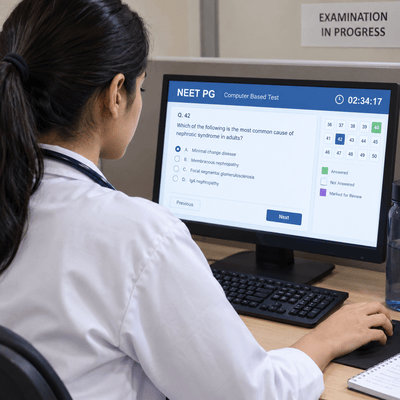
Choose your focus
A shorter mixed-subject test for a focused timed session.
36 questions · 42 minutesConcentrate on a single subject while using the same section-length format.
36 questions · 42 minutesWork through five timed groups in the pinned 2026-pattern practice format.
180 questions · 210 minutesThese are practice tests. A full mock identifies the verified pattern version it follows; official sittings can use different rules.
About NEET PG
NEET PG (National Eligibility cum Entrance Test for Postgraduate courses) is an eligibility-cum-ranking examination conducted by the National Board of Examinations in Medical Sciences (NBEMS). It is used for admission to MD, MS and postgraduate diploma courses, as well as other postgraduate medical pathways described in the applicable information bulletin.
For candidates, preparation involves more than recalling individual facts. Questions can ask for the best response to a clinical situation, interpretation of findings and application of knowledge from across the MBBS curriculum. ExamAcers brings timed practice, subject revision and full mock tests together in one place, with answer explanations to support review after each attempt.
For application requirements, eligibility, notices and the current information bulletin, consult the official NBEMS NEET PG page.
Exam pattern
The referenced bulletin specifies 180 multiple-choice questions in English, four response options per question and 3 hours 30 minutes of examination time.
The referenced pattern divides the paper into five groups of 36 questions, with 42 minutes per group. The next group opens automatically when the current group's time ends. Earlier groups cannot then be revisited.
A correct response receives 4 marks, an incorrect response deducts 1 mark and an unattempted question receives 0. Questions marked for review are evaluated under the same marking scheme.
Pattern details above are drawn from the NBEMS NEET PG 2026 information bulletin, sections 5.2-5.6. The bulletin notes that the actual number of time-restricted sections may vary for operational reasons.
NEET PG syllabus
The NEET PG syllabus draws on the subjects and knowledge areas taught during the MBBS course. For structured revision, the syllabus is commonly organized into three connected parts: pre-clinical, para-clinical and clinical subjects. Questions can combine knowledge from more than one part, so these groups should guide revision rather than be treated as isolated compartments.
Part A
Anatomy, Physiology and Biochemistry establish the scientific foundations of medicine. This part covers normal structure and development, body functions and regulation, and the biochemical processes that support health and explain disease.
Part B
Pathology, Pharmacology, Microbiology, Forensic Medicine and Toxicology, and Community Medicine connect basic science with medical practice. Revision includes mechanisms of disease, medicines, infectious agents, medico-legal principles, prevention and population health.
Part C
Medicine, Surgery, Obstetrics and Gynaecology, Pediatrics, Orthopaedics, Ophthalmology, Otorhinolaryngology, Dermatology, Psychiatry, Radiodiagnosis and Anaesthesiology apply knowledge to clinical presentation, investigation, diagnosis and management.
The three-part organization helps arrange ExamAcers subject practice; it does not imply a fixed question allocation for any part or subject. NBEMS states that the examination syllabus comprises the subjects and knowledge areas prescribed under the applicable Graduate Medical Education Regulations. Check the latest official NEET PG information for the syllabus and rules applicable to an actual sitting.
NEET PG subject details
The summaries below outline the principal areas commonly revised within each MBBS subject. They are intended to help you organize practice across the full curriculum; individual questions may integrate concepts from several subjects and clinical settings.
Part A
These subjects establish the normal structure, function and molecular basis of the human body.
Anatomy covers the structure and development of the human body through gross anatomy, histology, embryology and neuroanatomy. Revision should connect anatomical relationships with imaging, surface landmarks, congenital anomalies and the clinical effects of injury to organs, vessels and nerves.
Physiology explains how cells, organs and body systems function and maintain homeostasis. Important areas include nerve and muscle function, blood, circulation, respiration, renal regulation, digestion, endocrine control, reproduction and the interpretation of normal and altered physiological responses.
Biochemistry examines biomolecules, enzymes, nutrition, metabolism, molecular biology and the biochemical basis of inherited and acquired disease. Preparation includes relating pathways and laboratory markers to clinical conditions, deficiencies, acid-base balance and organ function.
Part B
These subjects explain disease mechanisms, medicines, infectious agents, legal responsibilities and population health.
Pathology studies the causes and mechanisms of disease and the structural and functional changes they produce. It includes cell injury, inflammation, healing, immune disorders, neoplasia, hematology and systemic pathology, together with interpretation of specimens and laboratory findings.
Pharmacology covers how medicines act, how the body handles them and how they are used safely and rationally. Revision includes pharmacokinetics, pharmacodynamics, system-based drug groups, antimicrobials, adverse effects, interactions, contraindications and therapeutic decision-making.
Microbiology addresses disease-causing bacteria, viruses, fungi and parasites, along with host immunity. Questions may involve transmission, pathogenesis, specimen selection, diagnostic methods, antimicrobial resistance, vaccination, sterilization, infection prevention and hospital-acquired infections.
Forensic Medicine and Toxicology applies medical knowledge to legal and ethical questions. It includes identification, injuries, sexual offences, death investigation, certification, consent, professional duties and the recognition and management of common poisonings.
Community Medicine focuses on health at population and community levels. Core areas include epidemiology, biostatistics, screening, prevention, communicable and non-communicable diseases, environmental and occupational health, nutrition, maternal and child health, national programmes and health-care delivery.
Part C
These subjects apply foundational knowledge to presentation, investigation, diagnosis, treatment, emergencies and continuing care.
General Medicine covers the assessment and management of adult disease across cardiovascular, respiratory, gastrointestinal, renal, neurological, endocrine, hematological, infectious and rheumatological systems. Clinical reasoning, investigation choice, treatment and medical emergencies are central.
General Surgery includes surgical assessment, perioperative care, trauma, shock, wounds, fluids and common conditions of the gastrointestinal, hepatobiliary, breast, thyroid, vascular and urological systems. Preparation also covers surgical infections, complications and emergency management.
Obstetrics covers pregnancy, antenatal care, labour, the puerperium, fetal assessment and obstetric emergencies. Gynaecology includes menstrual and reproductive disorders, infertility, contraception, infections, pelvic disease and common gynaecological cancers.
Pediatrics addresses health and disease from the newborn period through adolescence. Major areas include growth and development, nutrition, immunization, neonatology, genetic and metabolic disorders, childhood infections, system-based illness and pediatric emergencies.
Orthopaedics covers fractures, dislocations, musculoskeletal trauma and disorders of bones, joints, muscles and the spine. Revision includes examination, imaging, initial stabilization, complications, infections, tumors, congenital and developmental conditions, and principles of rehabilitation.
Ophthalmology includes visual assessment, optics and refraction, diseases of the anterior and posterior segments, glaucoma, cataract, retinal and neuro-ophthalmic disorders. Candidates should also recognize ocular manifestations of systemic disease and sight-threatening emergencies.
Otorhinolaryngology covers disorders of the ear, nose, paranasal sinuses, throat and related head and neck structures. It includes hearing and balance, airway problems, infections, common tumors, diagnostic examination and urgent ENT presentations.
This subject covers recognition and management of common skin, hair, nail and mucosal disorders. Revision includes infections, inflammatory and autoimmune disease, drug reactions, sexually transmitted infections, leprosy and skin findings that signal systemic illness.
Psychiatry includes mental-status assessment, classification and management of common psychiatric and substance-use disorders. It also covers psychopharmacology, psychological treatments, psychiatric emergencies, capacity, consent and relevant legal principles.
Radiodiagnosis focuses on selecting and interpreting common imaging investigations, including radiography, ultrasonography, CT and MRI. Preparation includes characteristic findings, contrast use, radiation safety and choosing an appropriate modality for a clinical problem.
Anaesthesiology covers preoperative assessment, general and regional anaesthesia, airway management, monitoring, pain control and perioperative complications. Resuscitation, fluid therapy, oxygen delivery and basic critical-care principles are also important.
These summaries are revision overviews based on the MBBS subject structure reflected in National Medical Commission curriculum material. They do not replace the applicable curriculum or the current NBEMS information bulletin, and they do not assign an official number of NEET PG questions to any subject.
How to practise
A subject test lets you concentrate on one part of the syllabus. A one-section test brings questions from across subjects into a 42-minute session. A full mock adds the five timed groups of the referenced pattern, including the wait for automatic progression and the inability to return to a closed group.
After each test, review the correct choices, your selected answers and the explanations. Use that review to identify topics for the next revision session. The practice question mix is an ExamAcers editorial choice; the examination authority does not publish a fixed subject-by-subject allocation in the referenced bulletin.
NEET PG FAQ
These answers explain the general examination framework. Dates, cut-offs, eligibility conditions and counselling arrangements can change, so always read the information bulletin and notices for your own admission session.
NEET PG is the National Eligibility cum Entrance Test for Postgraduate courses. It is an eligibility-cum-ranking examination used for admission to MD, MS and postgraduate diploma courses, together with other postgraduate medical pathways identified in the applicable official information bulletin.
The National Board of Examinations in Medical Sciences conducts NEET PG. NBEMS publishes the application bulletin, examination notices, admit-card information, results and related updates on its official website.
In general, an Indian medical graduate needs a recognised MBBS degree or provisional pass certificate, the required permanent or provisional medical registration, and completion of the compulsory rotating internship by the cut-off stated for that session. The current bulletin controls the exact requirements and documentary proof.
A candidate may apply while completing the compulsory rotating internship if the internship will be completed by the cut-off date specified in the applicable information bulletin. Missing that deadline can make the candidate ineligible for admission even after taking the examination.
Foreign medical graduates can be eligible when they meet the requirements in the current bulletin, including the applicable screening-test, registration and internship conditions. Because individual circumstances differ, candidates should verify their qualification and documents directly against the official eligibility provisions.
The referenced NBEMS pattern has 180 multiple-choice questions in English and a total examination time of 3 hours 30 minutes. It uses five time-bound groups of 36 questions, normally allowing 42 minutes for each group. Candidates should confirm the pattern in the bulletin for their own sitting.
No. Under the referenced time-bound format, the next group opens automatically when the current group's allotted time ends. Once a group closes, its questions cannot be revisited or its responses changed, so review must be completed before that group's timer expires.
A correct answer receives four marks, an incorrect answer results in a deduction of one mark, and an unattempted question receives zero. A question marked for review is still evaluated according to the final response saved for it.
The syllabus comprises subjects and knowledge areas taught under the applicable Graduate Medical Education Regulations. In practical terms, candidates revise the pre-clinical, para-clinical and clinical subjects of the MBBS curriculum, while expecting questions that can integrate more than one subject.
The referenced bulletin defines the overall paper and syllabus but does not provide a guaranteed question allocation for each MBBS subject. Subject-wise numbers circulated by coaching or educational websites should therefore be treated as estimates rather than an official blueprint.
The standard qualifying thresholds stated in the regulations are the 50th percentile for General and EWS candidates, the 40th percentile for SC, ST and OBC candidates, and the 45th percentile for unreserved candidates with benchmark disabilities. Authorities may revise a session's qualifying cut-off, so use the published result and subsequent official notices.
No. Qualifying makes a candidate eligible to participate subject to the applicable rules, but a seat depends on rank, category, eligibility, available seats, counselling choices, reservation policy and document verification. A qualifying score by itself does not guarantee admission.
The score is calculated from correct and incorrect responses under the marking scheme. The percentile describes a candidate's relative performance in the examination population, while rank orders candidates for the admission process under the published method. They are related measures but are not interchangeable.
The Medical Counselling Committee conducts counselling for the seat categories assigned to it, while state or union-territory authorities conduct counselling for seats under their jurisdiction. Candidates should follow the appropriate counselling authority because registration, eligibility, reservation and choice-filling rules can differ.
Use the official NBEMS NEET PG page for the bulletin, application and examination notices, and the relevant official counselling website for admission schedules. Dates shown on third-party pages can become outdated after a revised notice.
Compare one-section, subject and full mock tests before selecting your next attempt.