Complete paper
300 marks in three hours
UCEED 2026 has one English-language question paper with two compulsory parts. Part A lasts two hours and carries 200 marks; Part B follows for one hour and carries 100 marks.
UCEED practice
Understand the UCEED structure, practise its objective questions and develop the drawing and design aptitude required for Part B.
About UCEED
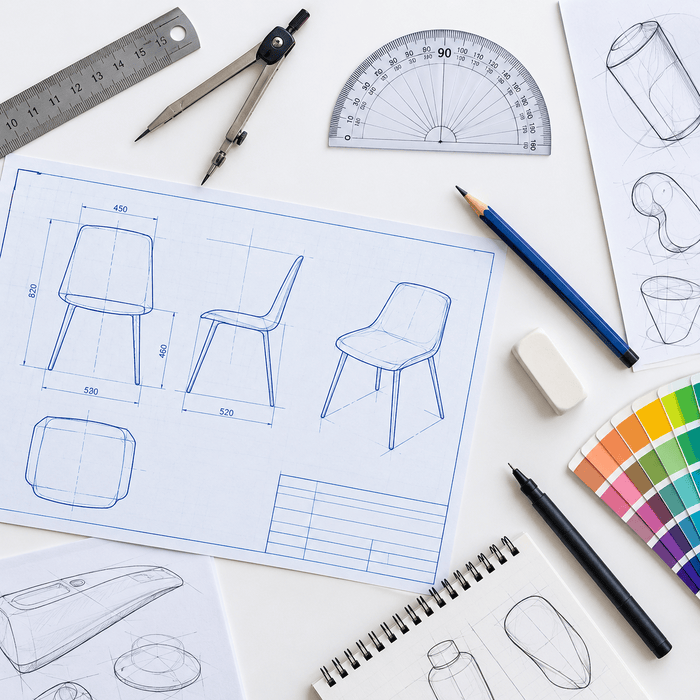
The Undergraduate Common Entrance Examination for Design, or UCEED, is conducted by IIT Bombay for admission to Bachelor of Design programmes at participating institutes. The examination assesses visual and spatial thinking, observation, reasoning, practical awareness, creativity, drawing and the ability to respond thoughtfully to design problems.
Qualifying UCEED does not itself guarantee admission. Participating institutes use the UCEED rank through their joint admission process, while result-sharing institutes conduct their own applications and admission procedures. Candidates must check the eligibility and application rules of every institute they intend to apply to.
For current announcements, brochures, schedules and admission information, use the official UCEED 2026 website.
UCEED exam pattern
Complete paper
UCEED 2026 has one English-language question paper with two compulsory parts. Part A lasts two hours and carries 200 marks; Part B follows for one hour and carries 100 marks.
Part A: NAT
Numerical Answer Type questions have no options. Each correct answer receives 4 marks, with no negative mark for an incorrect or unattempted response. The section carries 56 marks.
Part A: MSQ
Each question may have one or more correct choices. The section uses the detailed partial-marking scheme in the official brochure, deducts 1 mark for an incorrect combination and carries 60 marks.
Part A: MCQ
Each Multiple Choice Question has one correct option. A correct answer receives 3 marks, an incorrect answer deducts 0.71 mark and the section carries 84 marks.
Part B: Sketching
The sketching question assesses the ability to draw products, people or scenes with suitable proportion, perspective, composition, line quality and shading.
Part B: Design aptitude
The design aptitude question asks candidates to respond practically and appropriately to a problem or situation, showing ingenuity, sensitivity and empathy.
The pattern above follows the official UCEED 2026 question-paper structure. Candidates should read the current information brochure for the complete MSQ partial-marking rules and any later corrections.
UCEED syllabus
The official syllabus describes the abilities from which questions may be drawn rather than prescribing a conventional subject textbook. The listed topics are exhaustive and indicate the nature of the examination, although a particular paper may not cover every topic.
Part A
Part A combines visual interpretation, practical understanding, observation, reasoning, language and creativity through NAT, MSQ and MCQ formats.
Visualise and transform two-dimensional shapes and three-dimensional objects, and understand the spatial relationships between them.
Apply an understanding of scientific principles and the way familiar objects, materials and mechanisms work in everyday life.
Detect concealed properties in daily life, pay attention to detail and use classification, analysis, inference and prediction.
Recognise environmental, social and cultural connections with design and understand how designed outcomes operate within their contexts.
Analyse qualitative and quantitative information, identify relationships and reach defensible conclusions from the information provided.
Read and comprehend Standard English accurately, including meaning, relationships and implications expressed in a passage or prompt.
Understand and form verbal and non-verbal analogies, metaphors, signs and symbols, and make imaginative connections between ideas.
Part B
Part B requires candidates to communicate visually and develop an appropriate response to a design situation within the available time.
Draw products, people or scenes in proportion with clear line quality, composition, perspective and shading. Practice should develop observation and communication rather than decorative rendering alone.
Respond to problems and situations with practical judgment, ingenuity and empathy. Strong answers identify the user and context before proposing a clear and workable idea.
Read the wording of the official UCEED 2026 syllabus before making a preparation plan.
Eligibility and admission
UCEED 2026 examination
Candidates whose qualifying examination was first held in 2025 or 2026 may appear, subject to the official age and attempt rules. Students from Science, Commerce, and Arts and Humanities are eligible to take the examination.
Attempts and score
A candidate may attempt UCEED at most twice, in consecutive years. The score is valid for one year and only for admission in the corresponding academic year.
BDes admission
Admission requires a UCEED rank and satisfaction of the participating institute's Class XII subject requirements. Eligibility to sit UCEED does not mean eligibility for every participating institute.
For UCEED 2026, the birth-date and qualifying-year cut-offs are cycle-specific. Confirm them on the official exam eligibility page and check the separate BDes admission eligibility page.
Participating institutes
The official participating institutes for 2026 are IIT Bombay, IIT Delhi, IIT Guwahati, IIT Hyderabad, IIT Indore, IIT Roorkee and IIITDM Jabalpur. Candidates with Physics, Chemistry and Mathematics at Class XII are eligible to apply to all seven, while other streams have a more limited set of eligible institutes. IIITDM Jabalpur also accepts the specified Physics, Chemistry and Mathematics or Biology combination.
IIT Bombay, IIT Delhi, IIT Hyderabad and IIT Indore accept eligible candidates from all Class XII streams through the 2026 BDes admission process.
IIT Guwahati and IIT Roorkee require Physics, Chemistry and Mathematics at the 10+2 level for BDes admission.
IIITDM Jabalpur requires Physics and Chemistry together with Mathematics or Biology, as specified in the official 2026 admission eligibility table.
Other result-sharing institutes may use UCEED scores but do not participate in IIT Bombay's joint seat-allocation process. Apply to them separately and verify their individual rules. See the current official institute list.
Preparation tips for UCEED
Map practice to every Part A and Part B ability. Avoid treating UCEED as a conventional factual syllabus or relying on an unofficial topic list alone.
Use official papers to learn how visual, logical and design questions are framed. Review the reasoning behind every answer instead of recording only the score.
Practise NAT, MSQ and MCQ questions separately before combining them in timed sets. Adjust decision-making to the different marking and negative-marking rules.
Sketch everyday objects, people and spaces while checking proportion, perspective, composition, line confidence, light and shade. Short daily sessions build fluency.
For design aptitude prompts, identify who is affected, the context, constraints and purpose. Generate alternatives before selecting and communicating one practical response.
Complete Part A under its two-hour limit and move directly into a one-hour Part B session. This builds pacing and preserves enough energy for drawing and ideation.
Before applying
Eligibility dates, participating institutes, schedules, fees, seat information and operational rules can change between examination cycles. Use preparation websites for explanation and practice, but verify decisions against the current IIT Bombay UCEED website, information brochure and the admission pages of the institutes you intend to select.
Frequently asked questions
IIT Bombay has announced Sunday, 17 January 2027, in the forenoon for UCEED 2027. Check the official UCEED website for the detailed schedule and any subsequent changes.
The official registration portal lists registration from 1 October 2026, with the regular-fee deadline on 31 October 2026 and late-fee registration until 6 November 2026. Check the portal for closing times and updates before applying.
Use the online registration portal linked from the official UCEED website. Complete your details, upload the required documents and pay the applicable fee. Exam registration and BDes admission applications are separate processes.
The 2026 examination rules allow Science, Commerce, and Arts and Humanities students, provided all eligibility conditions are met. BDes admission requirements differ by institute. Verify the corresponding 2027 rules before applying.
Check the current cycle's age cut-off, permitted number of attempts and qualifying-examination year. Do not carry the 2026 birth-date or Class XII year cut-offs forward to 2027 without checking the new brochure.
Under the 2026 rules, candidates may attempt UCEED at most twice, in consecutive years. Check the next cycle's eligibility rules before planning another attempt.
The 2026 requirements include a photograph, signature, age proof and qualifying-examination evidence, plus applicable category or disability certificates. Use the current brochure's formats and checklist; appearing students may need the prescribed school certificate.
Contact the UCEED office at uceed@iitb.ac.in with your registration number, name, mobile number and a clear description of the payment problem. Resolve it before the application deadline.
No. Admission depends on institute eligibility, rank, reservation category, preferences and seat availability. You must also complete the separate admission application within its deadline.
Follow the joint admission announcement on the official UCEED website. The common application lets eligible candidates select institutes in preference order, upload supporting documents and pay the admission application fee.
Not necessarily. Result-sharing institutes outside the joint admission process require separate applications. Check each institute's course eligibility, fees and deadlines directly.
The 2026 rules make the score valid for one year, for admission in the corresponding academic year. Do not assume it can be carried into a later admission cycle.
Schedule checked on 1 October 2026. Eligibility and procedural examples identified as 2026 rules come from the official registration guidance, exam eligibility rules and BDes application guidance. Use the current cycle's brochure for your application.
Build visual reasoning, observation, drawing and problem-solving through focused sessions before moving to a full mock.